My cousin, Smacka

My cousin, Smacka, was cremated last week. Two things stood out about his overflowing funeral of some hundreds – what it said about him and the resonances of family it stirred in me.

First those resonances, the context for my being there:

As I get older I am drawn more to see the full cycles of my life; and I see more circles close.

The extended family grew up in a series of working class semis in Crow’s Nest. I lived in the house of the matriarch; my nanna. Smacka and his family lived a walkable distance away, as did a few of nanna’s other daughters and their families. Families hanging close is a common second generation custom.

The first generation huddled even closer together. In the decades around the turn of the nineteenth century almost every street in Miller’s Point housed someone who shared my DNA or married into it.

Smacka was the better part of a decade older than me, the younger of 2 brothers, a chalk and cheese duo. Barry the older was quieter, more studious, sometimes ill. Brian (Smacka) was a knockabout kid. He could have been a prototype for Ginger Meggs. Both boys, as befitting an Irish Catholic heritage, went to Marist Brothers at Mosman and discovered football.

I think it was he who pushed me, aged about 8, out of a rowing boat 100 metres from the beach at Balmoral. It was sink or swim and I learnt to dogpaddle. I still have small grainy black and white pictures of those family picnics. Now I take my own grandchildren there – 5 generations have played on the same sands.

At 18 Smacka as he was already known (a nickname which perhaps gave a hint to his personality), did what someone with that name might do – he joined the police force.

I remember the family consternation, the uproar, the criticism. The sons of a working class Irish family never became coppers. Coppers, it was rumoured, had to sign a pledge that they would even put their own mothers in jail if they did the crime. I remember becoming concerned for my Aunty Ruby, Smacka’s mother and the gentlest kindest of my aunties in whose kitchen I often sought comfort.

I lost memory of him from then on although I do remember going to his wedding. Ruby, dear Ruby, came to help me with my babies in the year before she died.

About 30 years later, I got elected to a position that some, not me, might consider to wield some power. Smacka got in touch. Could he visit? The time came and there he was on the doorstep with the boss of the local police region and a slab of beer, come to discuss matters of mutual interest.

Another 25 years passed and about 9 months ago the oldest of the cousins died. Spurred by sentiment I decided to gather many of the remaining cousins to lunch. Smacka and his wife came.

There he was on the doorstep looking ravaged by time, by the many cancers he had beaten, croaking through the voice box that had replaced vocal cords removed after cancer of the throat. And by his side was the Esky of beer that I presumed accompanied him to all social occasions.

He spoke little though that afternoon, a few wry comments. But he was there part of my childhood returned to me passingly before he died.

Who was he this cousin of mine?

I suppose I am writing this not just as a hook for my own memories but as a statement about people we are connected with who can live a whole life, achieve milestones, show kindnesses and we are ignorant of it all. A book on the shelf that we never bothered to read.

Smacka deserves acknowledgement because from what I heard at his funeral he was one of the last of a kind. A bigger than life Irish Australian character, the knockabout bloke who loved his sport and would do anything for his mates, a bloke who read Banjo Patterson, played golf when too old for football and went to the Melbourne races. Mates everywhere.

“He was all ours of a weekend” one of his daughters said. She recalled great childhood experiences of long car rides to bleached beaches on searing summer holidays.

This man always had a wry crack. Perhaps it was the years in the police force (including in the old 21st Division, the CID and Armed Holdup Squad). or the natural reticence of men of his generation, that made him dry and non-committal?

For me the funeral held some surprises. The tribute from the large copper, a very senior officer, in full dress uniform with about 5 gold stars on each shoulder could not continue because it took all his energy to stop the tears from spilling down his face. He clearly loved my cousin.

Smacka, who had taken early retirement because of the cancers which took first his voice, had risen by that stage to Detective Inspector and the sentimental talk at the funeral was that he could have been Commissioner, other things been equal.

So all that was a surprise to me. The other surprise was the battered elderly man in a leather coat with his own voice box, crying in the row in front of me. After retirement Smacka and his wife took over the Laryngectomy Association. We were told there wasn’t a hospital in NSW he hadn’t visited to counsel some suffering soul.

So there you have it, a dry knockabout lad who loved his sport, his mates, his family;

who rose up in the old tough NSW police force;

who showed indomitable courage in the face of years of illness;

who spent the last 20 years counseling those similarly afflicted;

who was remembered by men crying at his funeral;

and whose family thought he would be best remembered with a poem by Banjo Pattterson and a song from John Denver.

He was a cousin of my childhood and I missed his life.
1 Comment

Filed under Musings

The Street Where I Lived

A few nights ago, my son and I checked out a well reviewed new restaurant. The food was tricked up Cantonese. OK. The space was very Melbourne- although we were in Sydney – high black ceiling with pipes laid bare, Chinois motif with touches of shabby chic.
The remarkable thing about it was the location in a wide street of dark empty commercial buildings with their closed lunch cafes underneath. This was the street, Chandos Street, Crows Nest, where I grew up.

Fifty years ago, before the inevitable (close to a railway station) re-zoning of perhaps 3 decades ago, this was a neighbourhood. This was a street of working class semi detached houses with a corner shop and a life being lived by a motley collection of characters.

As the cliché goes, it was like yesterday. I can still see them all, hear the laughter and the shouting, smell the crackers and taste the pennyworth of lollies from that corner shop opposite.

If my family was colourful, the working class neighbourhood was more so. Every Saturday afternoon (until school sport spared me) I ran down the back lane to give Mr or Mrs Wilbow, the local SP bookies, some coins wrapped in a torn off page of a school book with the name of the favoured horse written on it. The Wilbows also ran a hamburger joint at St Leonards and their son Bobby was a magician.

A few doors down Keith, around my age, lived with his parents; his father sold clothes props from the back of a horse and cart. I remember Keith being beaten with the horsewhip in the lane one night. No-one did anything.

I was not allowed to talk to the Peterson girls who were around my own age. I gathered from overheard whispered gossip and hearsay that the father, a garbage man, was suspected of having “behaving badly” towards his elder daughter under their house. Again no one interfered in another family’s business.

But it was the Targets who took the prize. They lived on the other side of the common wall and I learned much of my later colourful language by listening to their fights, ear pressed on the end of a glass held against the wall. Both Mr and Mrs Target were alcoholics and some nights she wouldn’t even make it rolling home from the pub a few blocks down. Mrs Target would have to be helped from her prone position in the lane to her gate.

Cracker nights a large neighbourhood bonfire would be piled high in the back lane. Catherine wheels spinning on rough paling fences, foolhardy boys lighting rockets in bottles, squealing jumps over Tom Thumbs going off. One year Mrs Target got right into the swing of it pouring kerosene over her husband’s clothes on the line and setting fire to them. I remember the drama when my family called the ambulance to them a few times.

New Years Eve we would stand on the front verandah banging away with the saucepans frightening the evil spirits away from the year to come.

There was always someone around in Chandos Street or in the lane behind. Kids playing cricket, telling questionable jokes, planning cicada expeditions, dawdling from school or just sitting on the rough grassy edges of the bitumen backlane in the searing heat.

On Saturday afternoon, the pigeons had to be coaxed into the pigeon house after a long race from some exotic country town and their times clocked.

Lives were lived; women walked up to The Nest to the haberdasher or the ham and beef shop; families drank innumerable cups of tea and men boozed; passions boiled over; curtains were drawn and gossip crafted.

Now I see the dark silhouette of a commercial streetscape, within it the lights of a new restaurant or two. Urban adaption is again rolling over this street of my childhood. How many decades I wonder before people live here again and will it ever be as colourful as it once was?

Leave a comment

Filed under Musings

Vietnam 2 – a 3 day roller skate through Hanoi…July 2015

Presumptuous to have a view about a city where you spend a long weekend but hey! I’ve seen well paid travel writers do it on less. Anyway, it’s more about the memories and the photos than any real analysis, so here goes:

Around the lake.

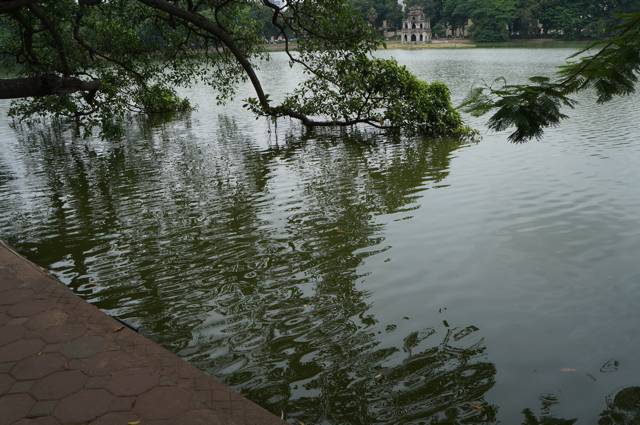
Ho Hoan Kiem (Hoan Kiem Lake) abuts Hanoi’s Old Quarter, the cultural and historic heart of the city. The lake is a wonderful, reflective, calm green surface which is in itself an insight into so much of Chinese painting. The Ngoc Son Temple (Temple of the Jade Mountain) sits on a small island on the southern end. Local people stroll around the tree lined lake, practise  at dance classes, do tai chi, play with children and generally relax

How many Chinese paintings did this remind me of?

How many Chinese paintings did this remind me of?

DSC05374

Chatting up the tourists

Having a dozzzzze by the lake

Having a dozzzzze by the lake

Being minded by nanna

Being minded by nanna

Fun in the open

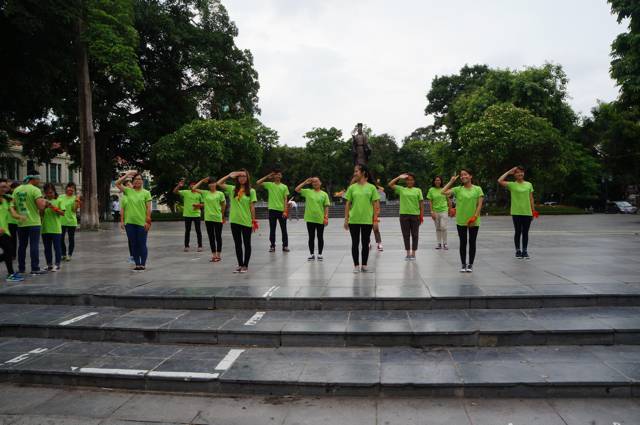
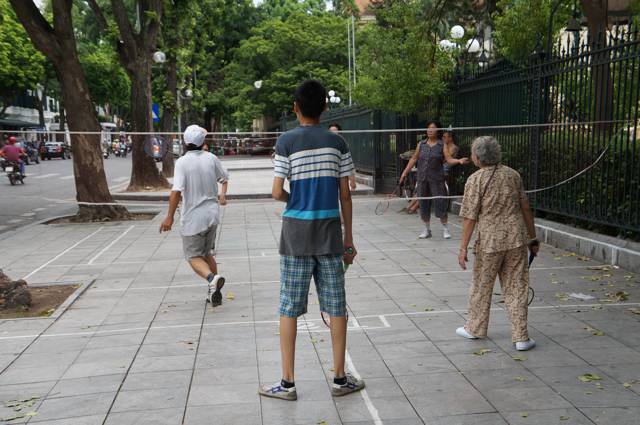
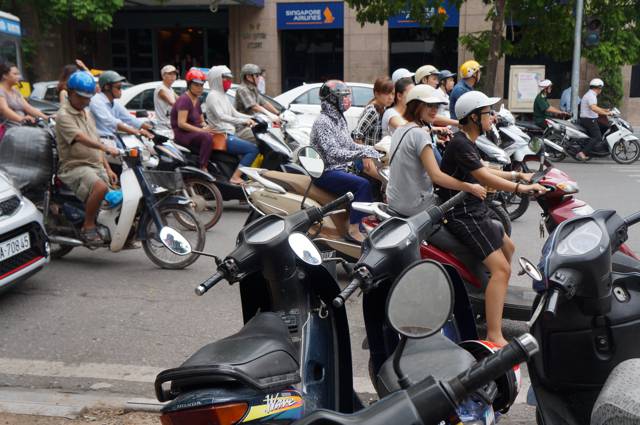
Much of life seems to be lived on the street in the centre of Hanoi. I saw schools practising their dance routines and tons of people playing badminton on the permanently marked courts along footpaths. My travelling companion was , unlike me, one for early morning walks when apparently the best of Hanoi is on display. The best reports were of up to 60 people at ballroom dancing class in the main square next to an equally large number seemingly attending laughter classes.

Students practising

Students practising

Roller skating

Roller skating

DSC05561

Here’s a great picture

Badminton!

Always the badminton!

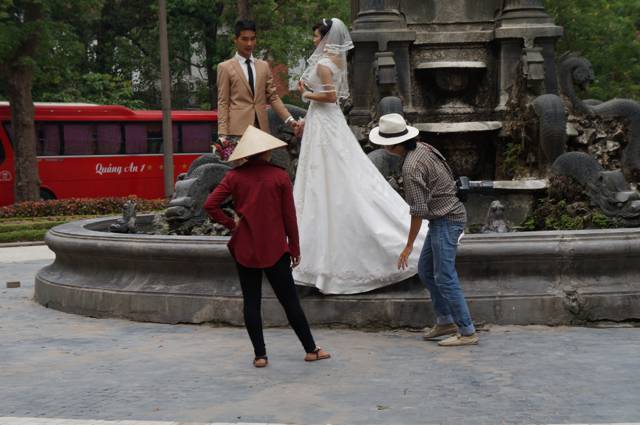
And of course, there were the ever present bridal photographs

DSC05544

DSC05546

DSC05383

We took an electric tourist car ride through the Old Quarter; narrow streets with discrete areas of speciality shops from suitcase to saucepans. Busy, life on the street again, this time commercial; here a temple, there a restaurant but all go!go!go!

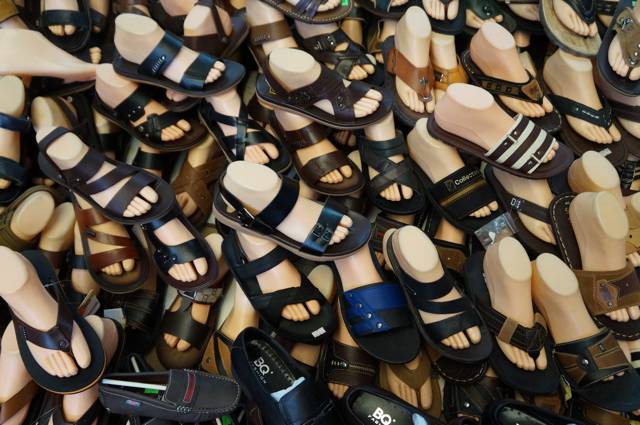
In the market building, some vendors went for the stylish presentation rather than the jumble bin approach.

DSC05353

DSC05350

Architecture

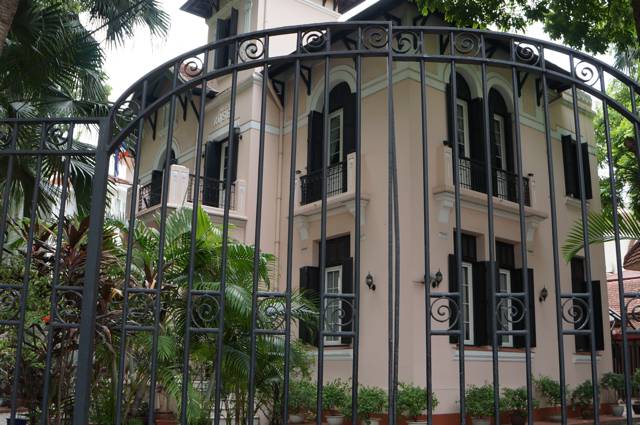
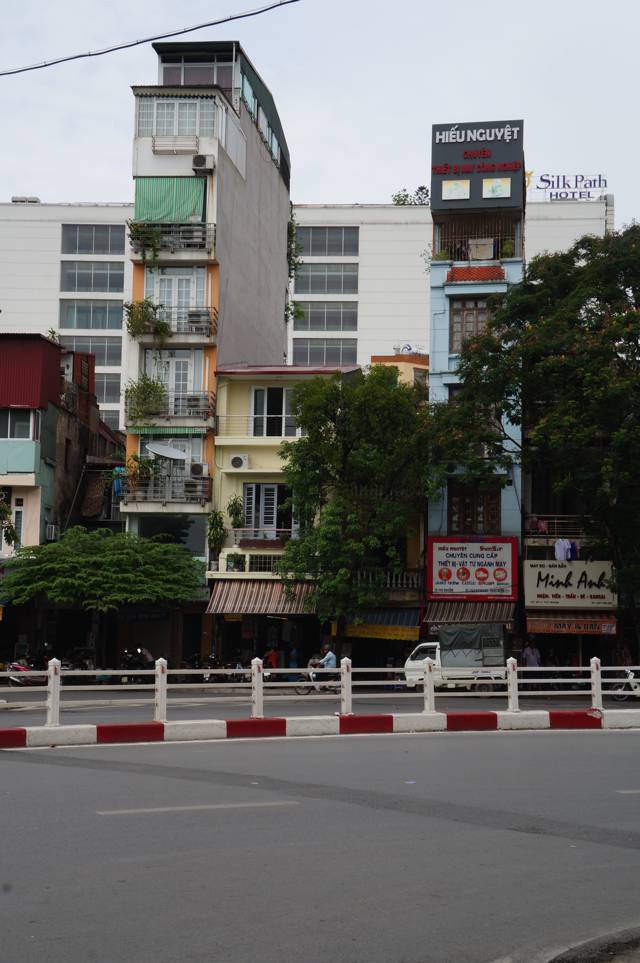
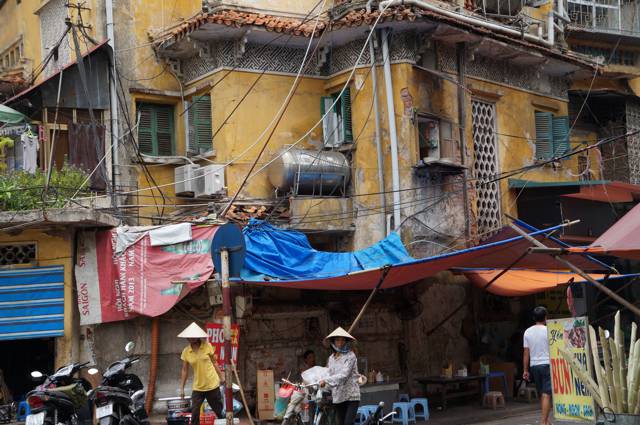
There’s the Old Quarter and then there’s the rest of the centre – a miss mash of sometimes refurbed and sometimes decaying French villas laid out in wide treed lined boulevards infilled with “the best that could be done at the time” in-fill. Some houses were so high and narrow there could be only one room on each floor; some were chaotic rearrangements of tumbling villas. Many of the commercial premises have been tacked onto what were once the small gardens of old houses and so they opened straight onto the motor scooter inundated footpath. The idea of a “building line” so dear to western town planners is a  fantasy in Hanoi. But it all hangs together with  cheerful ramshackle character.

One of the grand French buildings, now a government guesthouse

One of the grand French buildings, now a government guesthouse

DSC05474

Another villa – one of the foreign embassies?

Some are so narrow....

Some are so narrow….

While others just adapt

While others just adapt

Houses alone the disused tram track

Houses along the disused tram track

MUSEUMS AND TOURIST MAGNETS

Museum of Literature

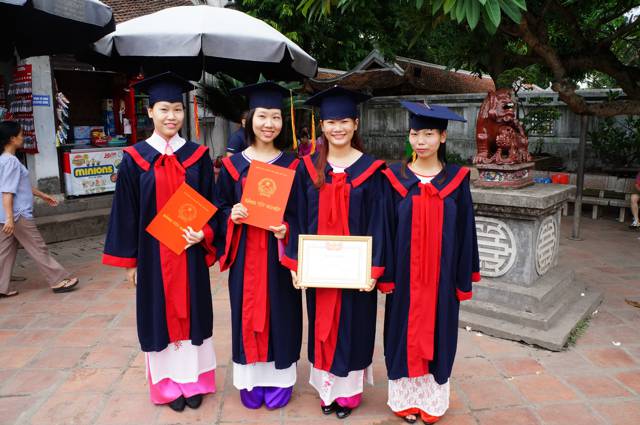
One of the most endearing sights was the group of young women graduates who came to pay tribute at the Temple of Literature,. In 1070 it was built as Vietnam’s first university and near as 1000 years later young women come to celebrate their graduation.

Before they donned their new academic robes

Before they donned their new academic robes

Proud as..

 and after….proud as..

The turtles corridor

The turtles corridor

And some cheeky topiary

And some cheeky topiary

Mao’s Mausoleum

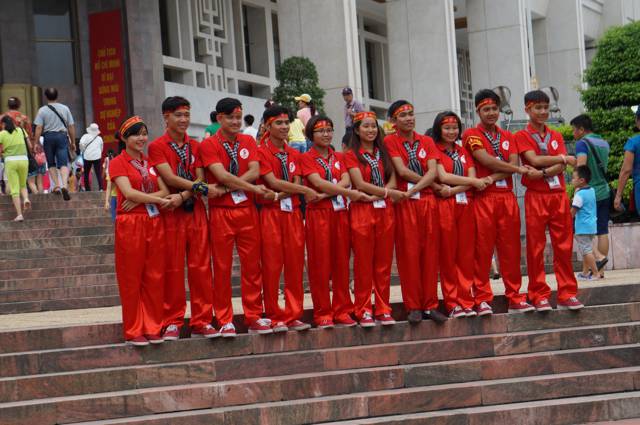
It took almost an hour for the 3k queue to get us to the door of his resting place where smiling and flashily dressed young guards indicated with a warm gesture that sunglasses were to be taken off. What pictorial memory of Hanoi would be complete without this photo?

DSC05459

And a youth group who had come to the Mao Memorial for the day

And a youth group who had come to the Mao Museum for the day

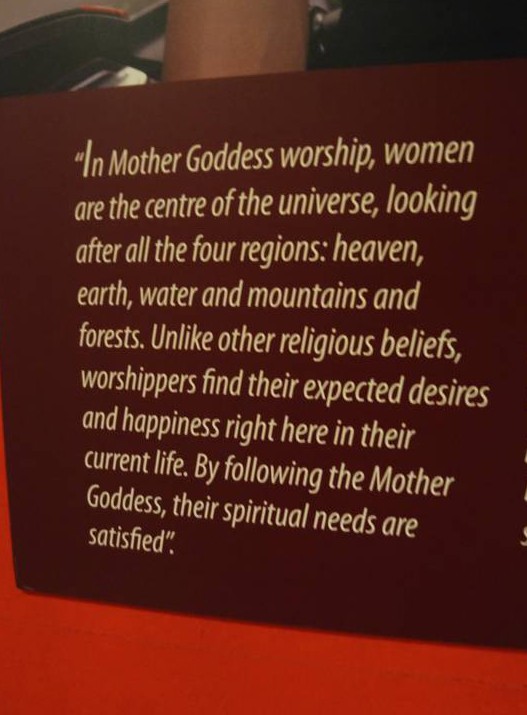
The Museum of Women was another on the roller coasting walk; it is smartly curated and this sign was memorable:

DSC05427

The Hanoi Hilton or Hao Lo Prison

This was a jail built by the French colonial government; its first prisoners arrived in 1899. The French kept mainly political prisoners here along with those awaiting sentencing at the nearby Court of Justice. It was originally built to house 500 inmates; at a peak in the early 1950s Hao Lo held 2,000 prisoners. During the Vietnam war American prisoners were held here with great kindness according to the panels describing their time; a view not consistent with some of the stories from those released prisoners.

DSC05449

A sculptural relief at the Hanoi Hilton

The last museum we had time to visit was the Museum of the Vietnamese Revolution. Well worth a visit; its wide 1950’s tiled corridors and rooms of glass cases and posters are a little evocative of Soviet influences but overall the museum details the people and the places that contributed to the struggle of the Vietnamese to attain freedom from French rule.

Life on the Street

From the chaos of the traffic to the groups of people sitting on low stools enjoying a footpath meal, there is much worth capturing in hanoi. I will let the pictures speak for themselves.

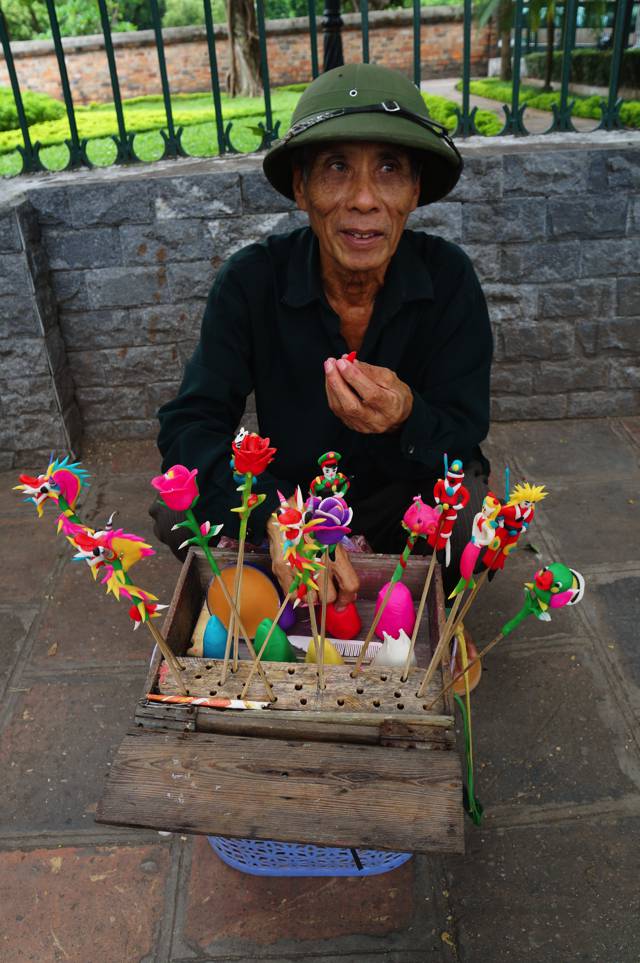
I have made these myself!

I have made these myself!

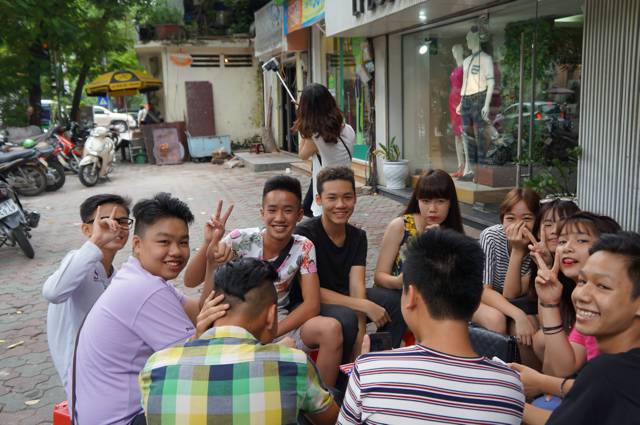
Students enjoying a meal

Students enjoying a meal

She could be in Paris or New York, an elegant woman reading the paper

Could be in Paris or New York, an elegant woman reading the paper

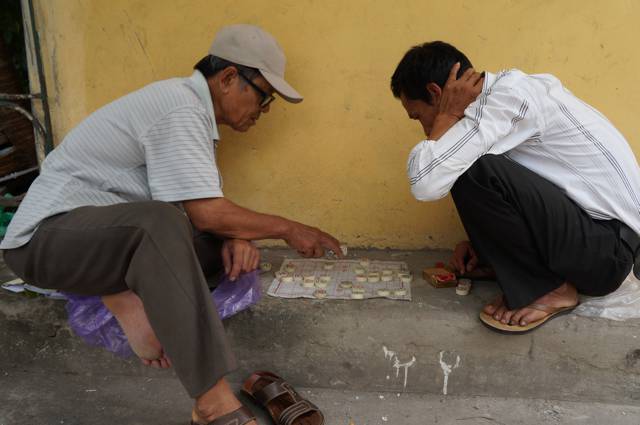
Always a board game

Always a board game

Who will ever sort this out?

Who will ever sort this out?

or this

or this?

Modes of transport

DSC05595

DSC05593

DSC05542

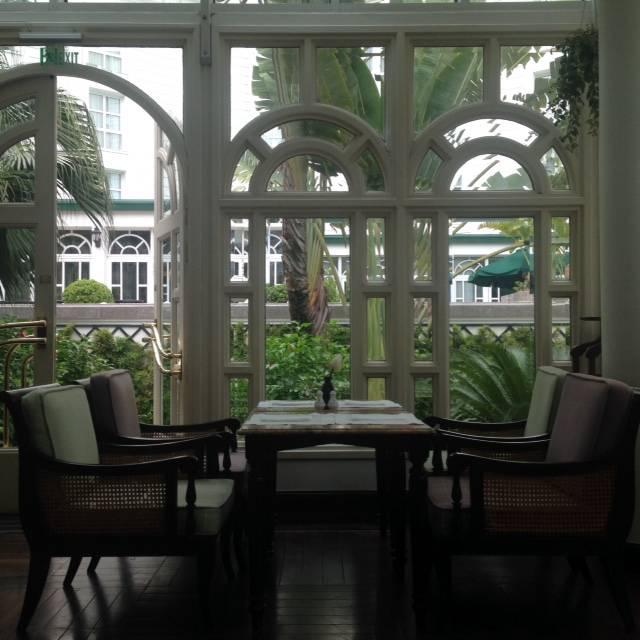
Finally… we stayed at the Metropole. One of the legend hotels. Its grand history boasts guests from Charlie Chaplin and Paulette Goddard on their honeymoon to Grahame Greene and Somerset Maugham, right through to their much loved Joan Baez and Jane Fonda.  And dozens as famous. Now there is a pool and perhaps the conservatory wasn’t there when Green sat to read of an evening?

IMG_4495

Great Pho

Great Pho

That really wasn’t the last word.

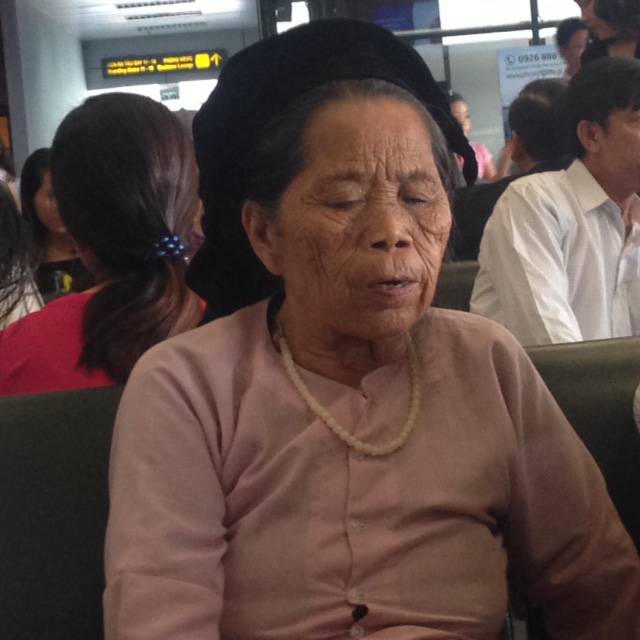
This woman sat opposite us at the airport leaving. She was flanked by two loving sons.

Her face seems to contain all the pain, determination and acceptance of Hanoi’s past. Bless.

IMG_4501

Leave a comment

Filed under Photography, Travel