Iceland 3…a few days in the Arctic North

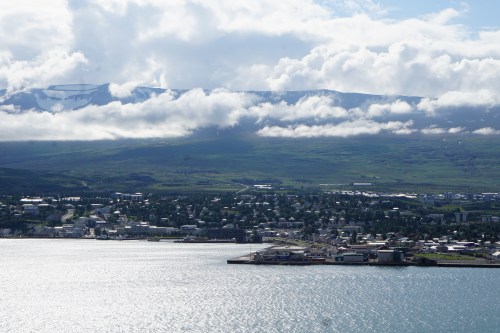
The flight from Reykjavik north takes us to the agricultural/tourist/service centre of Akureyri, a small (pop. 17,500) neat town at the west side of the inland end of the beautiful Eyjafjörður fjord.
dsc03059

Although about 100k from the Arctic circle, on this first day it is so warm that people sit outside cafes; presumably it is the locals in T-shirts.

img_0847

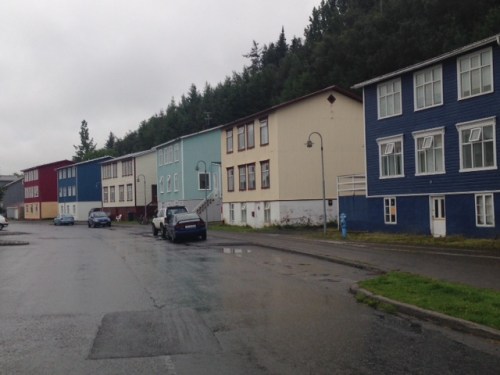
Norse Vikings settled the area in the 9th century. By the 17th century Danish merchants set up camp on the site of the now town and In 1779 the 12 permanent residents were (temporarily) granted a municipal charter!
img_3931

Our first visit was to the Arctic Botanic Gardens to wonder at some of the floral displays; the range begin to make sense as you realise that at this time of year, the sun shines almost round the clock. The garden were begun in 1910 when women from Akureyri founded the Park Association to beautify their city. The previous year the city had given them a hectare of land. It was the first public park in Iceland. The garden area has increased to 3.6 hectares. Its prolific range has proven that shrubs, trees and other plants can survive on the edge of the Arctic. Besides arctic plants, those from the temperate zones and high mountains are grown. There are about 400 Icelandic species and about 7000 species altogether.

After the Gardens we drive along the northern shore of the fjord to visit the   Laufas farmouse.

dsc03046dsc03003

Laufás is a renowned church site and chieftain‘s residence from settlement (874-930). The current Laufás church was built in 1865, among its special items is a pulpit from 1698.

The current farmhouse (below) which is now a museum typifies of a wealthy vicarage from 1853-1882 furnished with household items and utensils from the period.

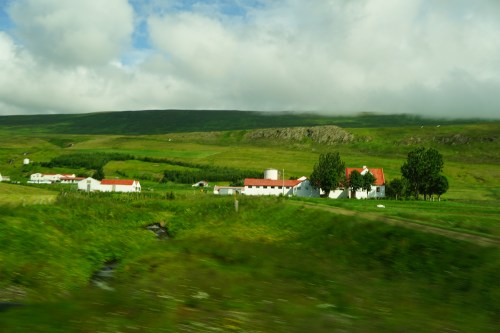
The drive is dotted with extraordinarily picturesque scenes of nestled farms, horses grazing and hay bales waiting for transport. Bright pink bales, a symbol of breast cancer awareness, stand out. Like everywhere in the world, people are slowly moving from the land into the town but when I think of what conditions must be like here in winter, I can sympathise. I also wonder about how these wonderful while farmhouses must disappear into the winter snow but then again, it is dark most of the winter time!

Next, an area full of geothermal and volcanic features

Lake Myvain (Midge Lake)

The next day we venture further visiting landscapes around Lake Myvain (Midge Lake) and I observe the good sense of tourists with full netting over their heads to protect them from the small flying irritants. The area is one of active volcanism not far from the Krafla volcano.

The lake and its surrounding wetland are prolific with birds. The lake was created by a large basaltic lava eruption 2300 years ago, and the surrounding landscape is dominated by volcanic landforms, including lava pillars and pseudocraters.

dsc03124

At the close of the Ice Age, about 10,000 years ago, the Mývatn basin was covered by a glacier which pushed up huge moraines which can still be seen at the north end of the lake.

(Moraines are accumulations of dirt and rocks that have fallen onto the glacier surface or have been pushed along by the glacier as it moves. The dirt and rocks composing moraines can range in size from powdery silt to large rocks and boulders. – I know this because one of our group had a PhD in glaciers!!!)

Godafoss

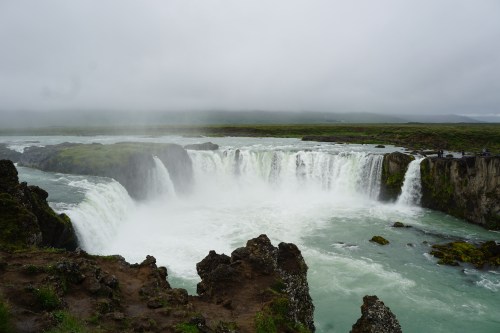
Godafoss waterfall (Waterfall of the Gods) perhaps so named because the Lawspeaker who proclaimed Christianity as the new religions of Iceland in the year 999 is said to have thrown his pagan statues in here. Whatever the reason, it is spectacular.
dsc03111

dsc03088

Dimmuborgir lava field 

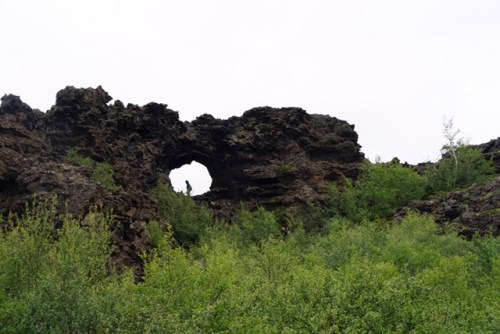
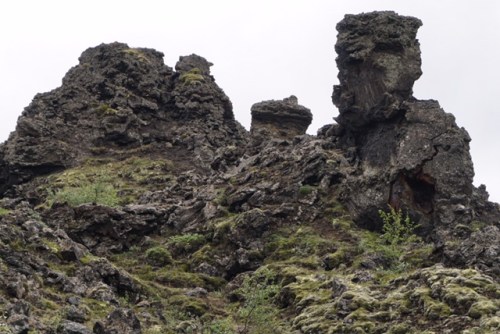
 Dimmuborgir “The Dark Fortress” is a true wonder. Dimmuborgir consist of fields of huge lava rock formations which make you feel like you stepped into another world – a world of fairy-tales. This is where trolls come from =this is their homeland surely? True, further south one can see their rock like silhouettes on the sides of hills and mountains but it is here in the lava towers they must have originated.
dsc03178

dsc03164

dsc03166

Hot lava streamed over these ponds trapping the water underneath the lava, and steam issuing through vents formed these pillars, which then remained standing even after the crust around them had gone away. The rocks are brittle and fragile because of how they came to be made. Walking along the pathways between the towering lava is truly an experience from Middle earth.

Grjótagjá

Grjótagjá rift is one of the best known underground caves in Iceland. It has two entrances with steps leading down to it. It is half-full with geothermal water and our guide says that as a boy he used to bathe in it. He explained an underground stream which brave lads swam beneath to reach the girls’ in a second cave.

During the eruption of Mt. Krafla in 1975-1984 the temperature of the water rose so it couldn’t be used for bathing until 2004. The temperature of the water is now too hot for bathing. We were warned against testing it although the potential danger didn’t seem to worry a few tourists; one man  clambered deep down into one cave regardless of a small baby he was carrying. This tourist below was only intent on his photo opportunity.

dsc03200

Hverfjall Crater

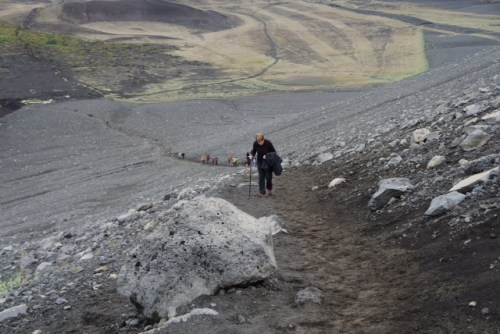
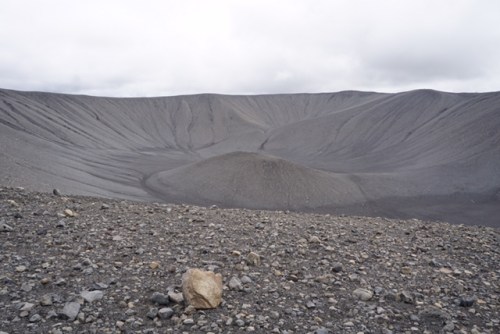
This day we also walked up Hverfjall, a bare symmetrical and circular explosion crater thought to be 2800 – 2900 years old. It is about 140 metres deep and 1km in diameter which makes it one of the largest of its kind in the world. To my shame I was a little out of breathe when I reached the rim.
img_1494

dsc03190

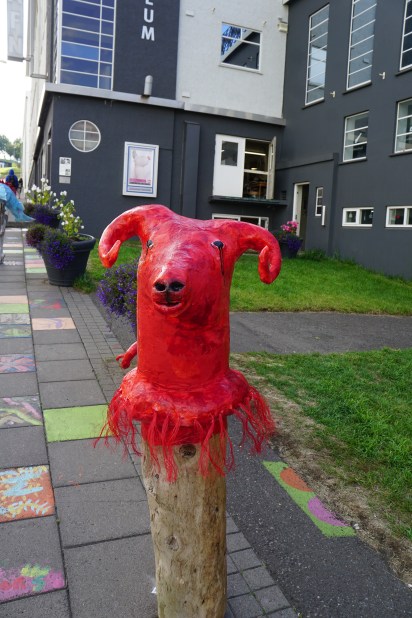
Lest it all be too physical and overwhelming, back in Akureyri there is a more than a decent cup of coffee to be had in a charming bookshop and more children to watch as they are chasing whatever one chases playing Pokemon Go! There are installations in the street outside the art gallery.
dsc03066

But the real surprise is one of the best Japanese entrees I have ever eaten (and there are about 10 Japanese restaurants in my neighbourhood).  A gastronomic surprise up here on the Arctic Circle, just down the street from the art gallery, the bright red Rub 23 serves Japanese, fusion, Asian and seafood. I was so impressed I bought the book. Below is the cod served as a main.

img_0853

1 Comment

Filed under Photography, Travel

Iceland 2….The Golden Circle plus some.

This blog is basically about the awesome tempestuous living landscape of Iceland.

From the moment I left the airport it was clear that this was a land different from any I had known. I was 100 k’s from the Arctic Circle but July warmish. The distant volcanic hills were snow patched blue, dressed in cloud, while in the foreground, intense green fields dazzled. Further along a 30 million year old mountain was ringed with lava.

dsc02920

Now was the time to leave the town and experience the land.

The Golden Circle

If you’ve heard anything about Iceland, this day trip is probably it. The story is that when Gorbachev and Reagan held a summit in Iceland in 1986, a US news team reported on the stunning country they visited in the down time. Since then, this round trip has starred on the tourist bucket list.

The Þingvellir National Park

Some 25 k’s east of Reykjavik, this is a UNESCO World Heritage site and home to the world’s first ”parliament”, a two weekly annual open-air gathering of the tribes that first met here in the Middle Ages (930AD) and continued until 1798 to make laws and settle disputes.

The Althing as the gathering was known (and as the current Parliament is still known) was held in a verdant field, an active volcanic site, fringed by a majestic granite cliff. A grassy knoll with an Icelandic flag is reputed to be where the Lawspeaker read out the laws agreed by the Althing.

Below is the granite cliff with the flying flag and the path that meanders through the site.


dsc02843

Here in the mists of time, paganism was the first religion before conversion to Christianity was proclaimed. Back in the day men were burnt here for witchcraft and women drowned in the lake filled with glacial water. Unsurprising then that these fields have provided one scenic backdrop for the popular “Game of Thrones” series.

Myth runs strong here. Trolls and elves are still part of Icelandic superstition and it is easy to see why. Tourists on the cliff top reminded me of the myths and legends – it isn’t a long stretch to see them as the tribes coming for the Althing gathering back in the day.


dsc02850

Through the fields of the first Althing, a wonderful walk takes you to the picturesque site of the first Icelandic (10th century) church rebuilt in the 1850s; it adjoins the summer home of the Prime Minister.


dsc02803

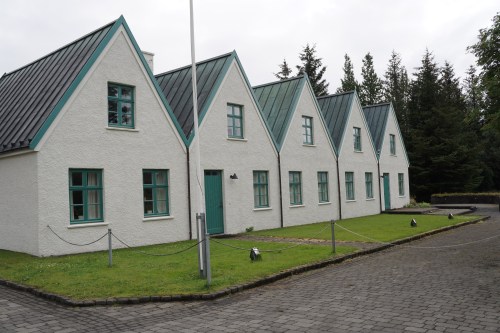
This house (above) is built in the old vernacular with the exterior of multiple matching front facades with a unified interior.


dsc02844

Further on you can peer into the remarkable chasm where the Northern American and Eurasian tectonic plates meet and diverge triggering natural ramifications like the 2010 volcanic eruption which affected air travel throughout Europe. Brave or foolhardy divers go deep here. This is truly an iconic place.


dsc02837

It is no surprise this is known as the Land of Ice and Fire

Gullfoss (Golden Falls) Waterfall

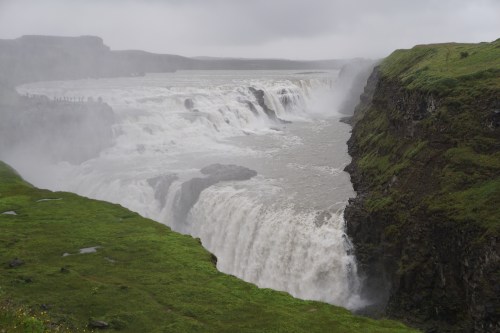
Our second stop is the spectacular double drop waterfall. The river plunges 32 metres into a crevice which is also 32 metres deep. Both falls are perpendicular to the flow of the river.


dsc02868

The endearing story is that Sigridur, one of 13 children, lived here on what was then a sheep farm (1874-1957). The farm had this massive powerful waterfall, Gullfoss. Sigridur and her sisters loved the falls and guided visitors there, cutting the first paths. She was self-taught, a well-read and talented illustrator and embroiderer.

Sigridur’s father was approached by foreign investors wanting to dam the waterfalls for hydroelectrical production but she fought to protect it.

It is said that she walked barefoot the 120km to Reykjavik, to urge the politicians and financiers to leave the waterfall alone. She threatened to throw herself over the waterfall if they were to be dammed.

She briefed a lawyer who later became Iceland’s first President. The investors could finance the deal. Gullfoss became a National Park in 1979. A monument to Sigrid stands at the site.

dsc02878


Geysir

There is something amusingly weird watching tourists stand around, cameras at the ready waiting for a spurt of water into the air.


dsc02894

“Geysir “ is actually the name of a specific grand spurter who has given his name to this phenomenon all over the world. He has been active for 10,000 years but now spurts rarely. It is said that in 1845 his eruptions reached 170 metres.

dsc02898

We are here to see another geyser and tourist ‘picture opportunity’, Stokkur who sits surrounded by petticoats of small geysers.


dsc02902

We leave the Golden Circle but not before a stop to visit a second waterfall and the “National Geographic” picture perfect beauty of salmon fishermen in an idyllic stream next to a fish ladder.

I was told these enthusiasts can pay up to US $5000 a day to the farmer for the pleasure of trying their hand at catching one of these fine fish in his or her lake.


Horses

Dinner that night is a surprise. It is at a tourist venue. Usually I would avoid such but in Iceland things seem different. It is a horse show. We are to see the famous Icelandic horses perform their famous fifth gait, a rocking horse movement known only to this breed.

So treasured are these small sturdy pure bred Icelandic horses that should one leave the country for whatever reason (sale overseas being a major reason) then they are never allowed to return due to fear of disease.

Driving back to Reykjavik in the light that lingers to near midnight, we pass fields of lava. I think I can see some trolls. Why wouldn’t there be since this land is alive?

dsc02956

Leave a comment

Filed under Photography, Travel

Iceland 1 Reykjavik…July2016

I don’t know where to start when talking about Iceland. The people? The history? The landscape? The towns?

I was and still am totally captivated by Iceland…so familiar yet so exotic. At times I felt I had journeyed to Middle earth.

There is so much information and too many pictures to choose from. Perhaps the best way in is to recap the main places visited in separate blogs and then list all those other facts I collected which round out the picture in a final.

So part 1 of the Iceland sage is Reykjavik, the main town.

Introduction

The 45 minute drive through flat rocky landscape from Keflavik airport is the first sign that Iceland is special. In the distance mountains and volcanos can be seen in every direction.

I learn that the rocky field are in fact fields of lava, Iceland having a third of the world’s lava flow with an eruption on the south coast around every 2 years.

We pass satellite towns of smart new developments. Iceland is strange but the architecture of these new suburbs about 10 years old bring a note of the familiar as does the heavy 5pm traffic flows. There was a building boom here between 2000 and 2008 preceding and in part generating the Icelandic fallout from the Global Financial Crisis.

Reykjavik

What a splendid small lively town swamped by tourists. About 240,000 of Iceland’s 320,000 people live in the capital. More than 1 million tourists would pass through here annually.

dsc02653


We stayed at the stylish art deco Hotel Bork on Parliament Square, central to everything. Such temperate days with some in shirt sleeves but I hear that in winter the pavements are heated with the abundant cheap thermal electricity.

While there are many smart, opulent satellite suburbs radiating out from the old town, the centre retains a  number of the old houses built of colourful corrugated iron.


dsc02602


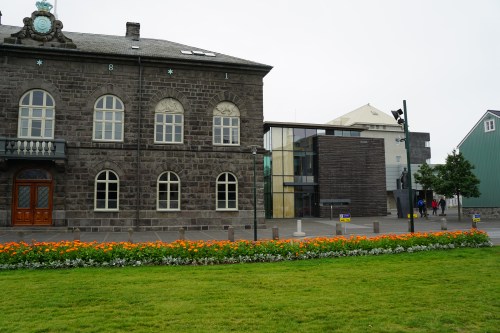
Parliament Square is the home of the Althing, a surprisingly small and unpretentious 19th century stone building with a smart extension – surprising until you remember that the population is only 320,000, less than many local authorities/cantons in the western world.

This Parliament is symbolically important as the descendant of the world’s first Parliament when the chieftains with their law reading and judges met annually in the fields 45k west of here.

In this square in 2008 the people gathered to demand action on the financial crisis causing the State to take over the banks’ debts. By November, what is now known as the “pots and pans” revoltion happened. People made constant protest noise with these kitchen tools . The police had to keep calm. Some people started dressing in orange to signify peaceful protest and stood between the police and those with less calm dispositions.

It was suggested that the  bright orange floral borders are an ongoing reminder of those protests.

dsc02595

The Althing, Parliament House.

Below is one of my favourite monuments in the square – the Monument to Civil Disobedience – reminding citizens of their right to oppose unjust laws


Now after 8 years, the debts are paid and young people who went abroad are being encouraged to return.There now seems to be a new wave of construction although the few Icelanders I spoke to were wary, working harder than ever to set themselves up debt free and hoping the cycle was not returning.

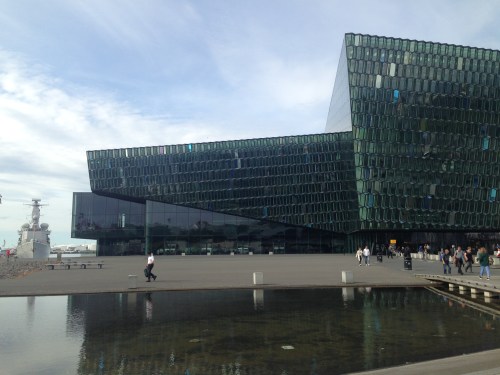
Harpa Hall the concert hall, was being built on the waterfront as a convention centre, hotel etc. by a bank when it went bust in 2008; the government bailed them out and this huge cultural centrepiece was completed by the national and city governments. 1.7million visitors a year enjoy this standout building of geometric glass shaped panels. It is a beautiful, imposing building even if perhaps out of scale with the town.

An explanation of the complex but yet simple acoustic system still remains a mystery though impressive to me!

img_3874


img_3870


dsc02771

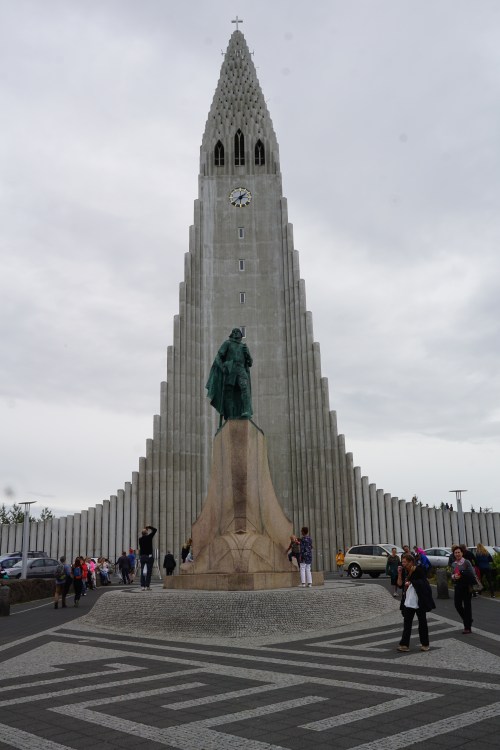
Hallgrim’s Church, the main Lutheran church stands out from a distance; it was commissioned in 1937 and took 41 years to complete. it is said to be designed o resemble the basalt lava flows of Iceland’s landscape.

dsc02708

There is a Settlement Museum in town showing an excavation where the first earth and stone houses lay under the foundations of the current town. It also contains copies of  the Book of Icelanders (1130) and the Book of Settlements (13th and 14th Centuries)

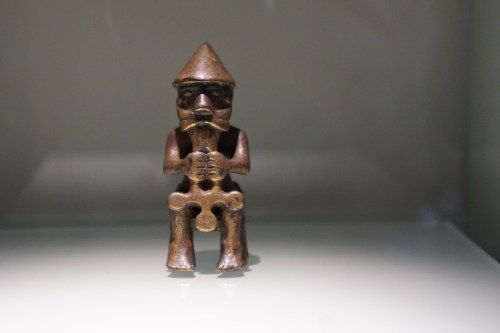
The National Museum has a statuette which is believed to be of the god Thor one of the few remaining artefacts of the pre Christian culture.

dsc02632

The pedestrian area is lively as in many tourist towns though the Japanese tourist below needed a quick nap in a quiet spot:

dsc02747

Just down the street, crowds were settling in, playing Pokemon Go!!

dsc02725

Graffiti is always fun:

The installation (?) below was signposted as “speed dating”

dsc02737

The best way ever of signalling the beginning of the pedestrian only area:

dsc02718

We also visited Asmundur Sveinsson Sculpture Museum. Sveinsson, a popular 20th century sculptor, designed the impressive white museum.The public art, to my mind, was indicative of the respect shown to artist in Scandinavian countries .


These young ones had no interest in the sculpture garden, nor anymore in their skateboards. It was device time as in most parts of the young world now!

dsc02680

Public sculpture too, pleases the eye:


Eating could be interesting too

I enjoyed watching the crowd at one posh restaurant, the Grillmarket, where there was one entrée of 3 sliders filled respectively with puffin, minke whale and lobster. I sat at the bar watching dish after dish of minke whale leaving the kitchen. I enquired of the meat the girl next to me was eating. I was told it was the best horse in town.

img_3880

Wine like most things in Iceland was expensive There were Australian wines: – a Wolf Blass President’s Selection at17,900 IK a bottle ($195) and the familiar old Jacob’s Creek cab sav for $359 (gulp). Coffee was $5.90 in most places and glass of Spanish wine about $16.

It wasn’t all chocolates

Lest I have been too carried away, let me give you the one sour note. There I was sitting in bed chewing chocolate when I felt a strange object floating in my mouth. Half a back tooth! The hotel found an emergency dentist. The taxi driver was a gem, walking me out of the cab to the 5th floor or an empty commercial building in a distant satellite suburb at 10.30pm and picking me up. The cheery (and obviously well off dentist as he was off to the Caribbean the next day with his 4 kids) was  equally kind and concerned. What nice people these Icelanders were.


More to come……..


Leave a comment

Filed under Photography, Travel